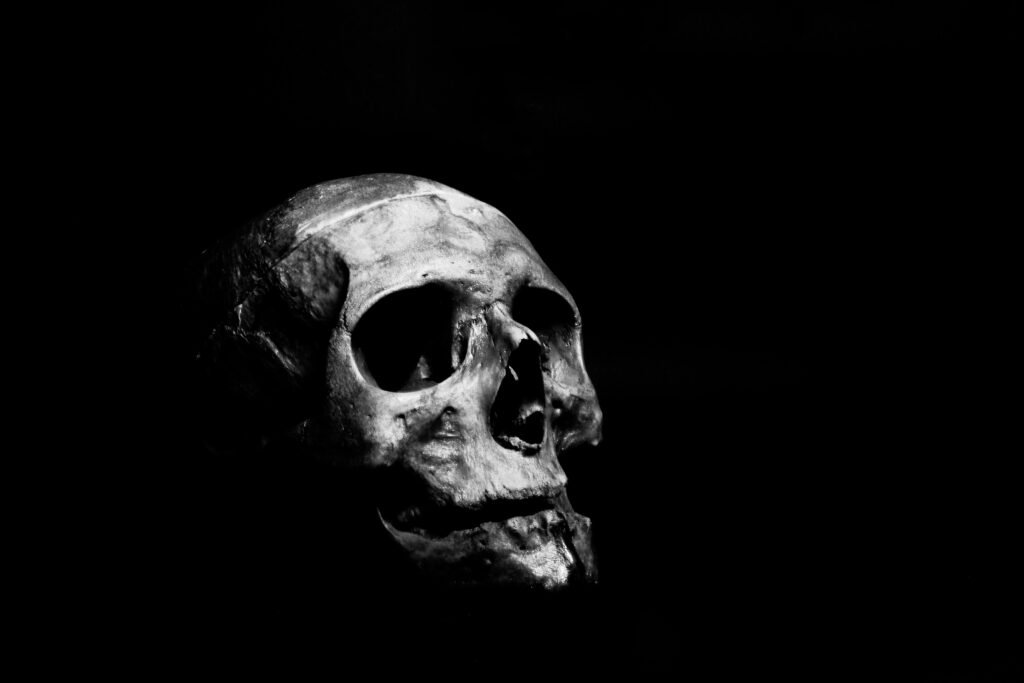
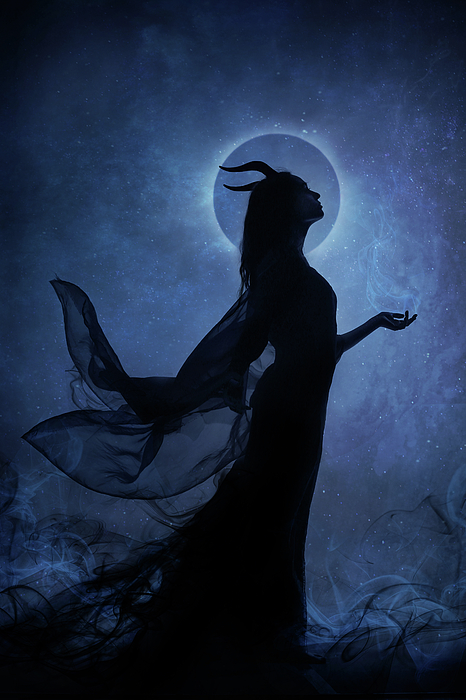
If you've found your way here, I assume that means you've heard the call of Lady Death, and just maybe you're ready to answer. Death witchcraft at its core uses the energy, metaphor, or personification of Death to empower the spiritual practitioner. Rather than viewing Death as a tragedy or a sense of loss, it is viewed as a transition or transmutation of energy.
"A witch stands on the very edge of everything, between the light and the dark, between life and death."
As a Death Witch, this is one of my favorite topics to teach on, but it is important to note that you do NOT have to identify as a Death Witch in order to practice death witchery in the same way that you do not have to be a Green Witch to use plants or herbs in your spiritual practice.
Death is something that all humans have in common regardless of any other defining factors of our lives and is widely related to many different spiritual traditions and mystical paths, so do not let a concern with arbitrary witchcraft labels deter you from joining if you feel the pull to work with Death.
Through The Death Witchery Mentorship Program, you'll be mentored by Kate Jade on many different forms of Death magick and working with Death energy, including:
Learning Death mysteries
Conquering the fear of Death
Communicating with the dead
Working with and honoring Death deities
Working with ancestors
Navigating working with liminal space
Understanding ancient funerary rites and traditions
Synchronizing with cycles of death in nature
Learning to respect Death and the dead
Practicing death walking
Navigating death spells
Leaving offerings for the dead
This program is in-depth and works with heavily experience-based witchcraft training that isn't readily available for online consumption. Interested students have the option to subscribe monthly for exclusive access to the mentorship program.
$666/month — Necromancer Tier | 1-on-1 Mentorship Access on Death Witchery
$333/month — Ritualist Tier | Premium Group Mentorship Access on Death Witchery
$66/month — Spiritualist Tier | General Content Access on Death Witchery
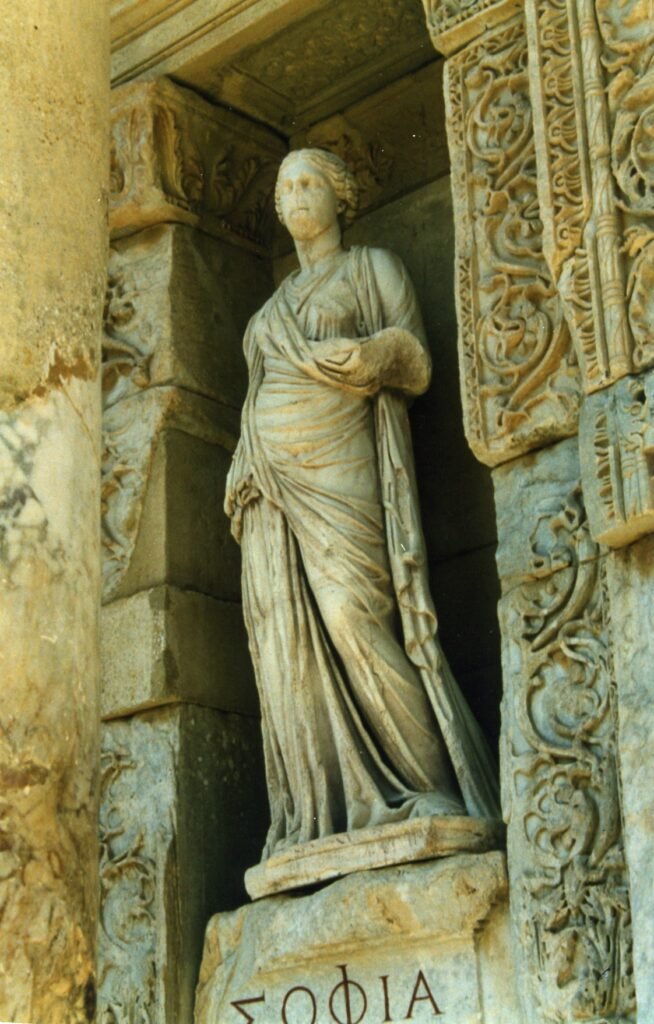
Sophia is the Greek word or name for Wisdom: σοφία.
“I am the Wisdom of God, the wisdom He used to build the world. I was with Him as He laid the foundations of the universe and placed the stars to light the firmament. I am the Wisdom through which your kings and rulers use to govern their kingdoms. Without me, they are lost and end up driving themselves and their own kingdoms to ruin. You seek me, and at the same time despise me. You prefer Ignorance to me. You love me and hate me at the same time. Who I am? I am Sophia, the Lady Wisdom.” —Sophia
Sophia is a central idea, concept, goddess, or personified divine being in Hellenistic philosophy and religion, Platonism, and Gnosticism. It’s worth noting here as well that the word philosophy (philosophía) itself is directly linked to the figure of Sophia as well and literally translates to lover of wisdom. So, to be a philosopher is quite literally to be a lover of Sophia, a lover of Wisdom.
We have a brand new class titled The Lost Wisdom of Sophia, and in this virtual offering, students will discover the truth of the Gnostic Goddess Sophia, her synchronicity with other divine feminine beings, quiet erasure from biblical texts to preserve religious patriarchy, and the ancient wisdom that she taught her followers.
Recently, there has been a tremendous amount of discourse surrounding the "proper" spelling of Magic/Magick in English. This is not something of relevance in other languages as they use the same word and spelling to represent both ceremonial magick and other forms of non-ceremonial magic (or even stage magic).
For us at Astarte's Temple, we have no personal preference on how other people choose to spell the word. We have opted to use the spelling of "magick" with a "k" for the purposes of our online presence for a few different reasons and want to be clear and intentional as to why we've made this choice.
First off, the earliest use of the spelling of "magick" that we know of is the work of Heinreich Cornelius Agrippa, who was a 15th and 16th-century physician, occultist, and philosopher. Philosophy or to be a philosopher, is to quite literally be a lover (philo) of wisdom (sophia), and at the end of the day, that is our heart at Astarte's Temple.
Agrippa was undoubtedly the most influential writer of the Renaissance Esoterica. His magnum opus, De Occulta Philosophia – Three Books of Occult Philosophy, remains one of the leading texts of Western esoteric thought even 500 years later. Do we 100% agree with everything Agrippa wrote or believed, no, but we would say that for most writers, teachers, and philosophers throughout all traditions of occultism, esotericism, and metaphysics.
Of course, as most know in modern times, the spelling of "magick" with a "k" was re-popularized by Aleister Crowley in the 20th-century, as he was influenced by Agrippa's work, and many were (and still are) influenced by Crowley's work to this day. We feel it is important to note that at Astarte's Temple, we don't use the "k" in magick" due to Crowley's use of this spelling, nor do we adhere to Crowleyan traditions.
Ultimately, as with everything in someone's spiritual craft, the choice in how they practice and share their practice with the world is their own. A choice to argue about how someone else should spell a word they use in their craft is time and energy that could be directed into the magic/magick/majick being cast. Remember, everyone has their own views, ideology, and reasoning behind what they believe and how they share it with the world. And no matter how a person spells it, if their goal is to bring more magick into the world, heal, grow, evolve, and draw nearer to wisdom, we are supportive.
Many symbols that relate to occultism, paganism, spirituality, witchery, magick, and the like, are often labeled as "evil" or "demonic." Sadly, it's to be expected. What often surprises me, or catches me off-guard, I should say, is when people WITHIN one of these "spiritual" communities perpetuate narratives that are not only false but actually harmful.
Recently, this has come up specifically with the symbol of the ouroboros, and I felt that the only way to appropriately address this was to unpack what I have been seeing said vs. what is actually true about this symbol historically, metaphorically, and mystically.
Since everyone may not be familiar with the ouroboros, as everyone's path, knowledge, and connection with various symbols will differ, I want to start with unpacking what it is first.
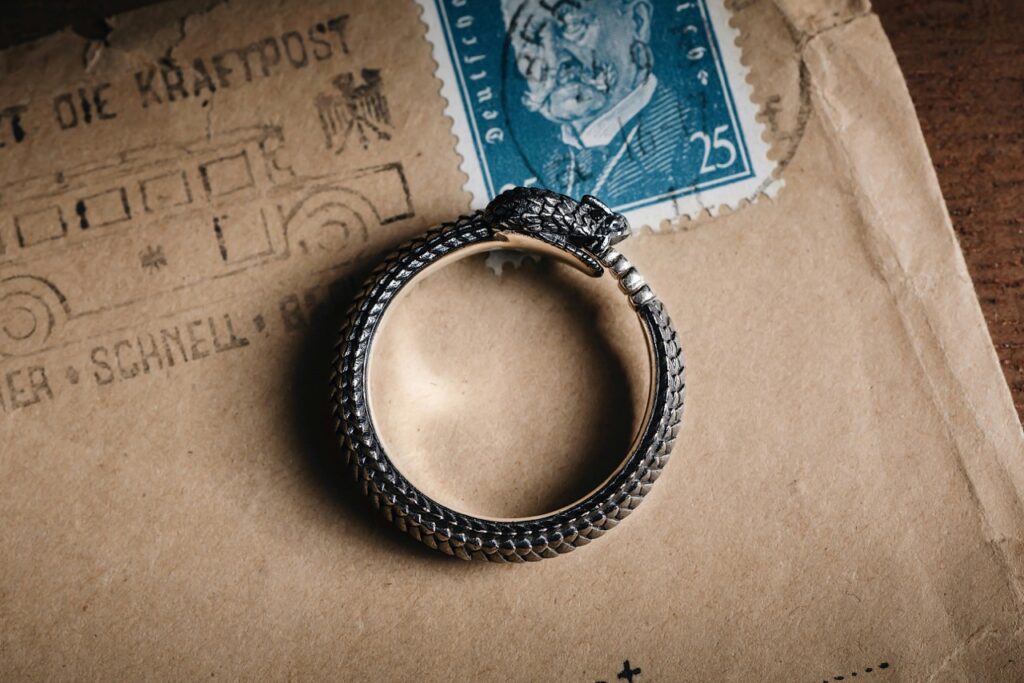
Ouroboros is typically pronounced: OR-OH-BOR-OS and while the word Ouroboros has its origins in the Greek language (literally meaning tail-eating), representations of the symbol itself have been documented as far back as the 13th and 14th centuries BCE in ancient Egypt.
Sometimes depicted as a snake eating its own tail and sometimes depicted as a dragon eating its own tail, the meaning remains the same—it expresses the unity of all things, material and spiritual, which never disappear but perpetually change form in an eternal cycle of destruction and re-creation. This aligns with what we understand as the First Law of Thermodynamics: energy cannot be created or destroyed, only converted from one form to another.
"Energy cannot be created or destroyed, only converted from one form to another."
The Meaning of the Ouroboros
Linked with the imagery of the goddess, Hekate, the Ouroboros and Anima Mundi are related philosophical and alchemical concepts, both representing cosmic unity, eternity, and cyclical creation. The ouroboros is the image of a serpent eating its own tail, symbolizing eternal cycles, while anima mundi, or "world-soul," is the concept that the universe is a single living organism with a soul that animates and connects everything within it.
The Ouroboros image can be seen as a direct visual representation of the Anima Mundi. Its cyclical nature embodies the continuous cycle of creation and destruction described by the Anima Mundi concept.
Just as the Anima Mundi is the animating principle of the universe, the Ouroboros is often depicted as a cosmic serpent that encompasses the world, binding it together as a single entity.
What the Ouroboros Means for Spiritual Practitioners
All throughout Astarte's Temple, The Mystic's Journey, and the books and articles I've authored (Kate Jade), you'll see me harp on the importance of paradoxes, symbolism, and infinite expansion.
So, let's unpack each one of these.
With the idea of infinite expansion, which I link to the Fibonacci Sequence (Golden Ratio) and its reduction down to the number 117, it directly connects to the goddesses Astarte and Hekate. In relation to the goddess of wisdom and the cosmos, Astarte, she has 117 manifestations that she takes on that make way for infinite possibilities in the universe, just like the infinitely expanding sequence of numbers discovered by Leonardo of Pisa, also known as Fibonacci. Infinite expansion is only possible through energy constantly taking on new forms as old or smaller ways of existing are transformed into new or bigger ways of existing. This is the cycle of death and rebirth, which is really just energy changing states infinitely as it expands and evolves.
If you think of the shape of the Fibonacci Sequence or Golden Ration (the spiral that infinitely expands), you can overlay the Ouroboros on it and see how every time the snake comes around to eating its tail again, it is shedding the old and growing bigger into a new form. This pulls in the imagery of the Anima Mundi, or Hekate, the goddess of magick, mystery, and liminal space because all of this exists within the fabric of the universe in a way that animates all of it and yet is nearly undetectable from the human perspective and experience. The ouroboros, though, will always come back around to the same point again but with expansive lessons and greater ideas that allow it to stretch into the vastness of the infinitely expanding universe we exist in.
This leads right into the heart of the symbolism of the Ouroboros for spiritual practitioners. Magick is in EVERYTHING whether people are capable of seeing it or not, and whether they choose to connect with it or avoid it. It's energy. And more specifically, it's energy that's being intentionally directed, literally moved in order to act as a catalyst for change and evolution. For witches, healers, empaths, shamans, and mystics, this is the point of all. The Ouroboros is the symbol for every step we take in infinitely expanding spiritually, psychologically, and physically. Every choice we make to learn, expand in wisdom, and integrate all of life's lessons into who we are as we pursue authenticity, balance, and joy.
Without the ability to alchemize and change, we would stay forever stuck in the same cycles and way of living with no hope of evolving. And that is where the nature of paradoxes comes into this, as well, because in the same way that the Ouroboros can eat its own tail as a process for evolution, it can also eat its own tail in a never-ending, self-sabotaging cycle when the individual refuses to learn or grown.
The Problem With Modern Narratives
This leads me to the current problem I've been seeing from "New Age" and "Lightworker" pages that have been recently speaking out on the Ouroboros symbol. They've labeled it evil. They've said it represents toxic cycles. And they are encouraging their followers to "stop eating their own tail" and "avoid being like the ouroboros"...and if you've been listening to this rhetoric, I hate to break it to you, but this is the same harmful narrative that is perpetuated by religious circles, monotheistic organizations, and suppressors of the divine feminine.
For the same reason it is problematic to say that the "Yin" portion of Yin-Yang energy is "evil" or "bad", which I have sadly seen circulating around the internet coming from "light focused" spiritual pages, saying that the ouroboros is evil and a symbol of toxic cycles is equally as harmful.
Maybe you're nodding your head right now saying, "Yes! How could someone think that?" Or maybe, you've gotten to this point in the article, and you're asking, "Wait. What? I thought it was bad..."
Here's the thing. If "Yin" energy is "bad", then here is what else you have to label as evil:
Feminine energy
Divine feminine
Goddesses
Darkness and nighttime
Water
The ocean
The moon
Mothers
The womb and birth canal
Movement
Receptive/receiving energy
Nurturing
Healing
Restoration
Lymph, cerebral spinal fluid, blood, synovial fluid, etc.
If the Ouroboros is "bad", then here is what else you have to label as evil:
Feminine energy
Divine feminine
Goddesses
Changing of the seasons (spring, summer, autumn, winter)
New friendships or relationships
Waking in the morning/falling asleep at night
Transitions like dawn or dusk
Birthdays, anniversaries, or milestones
Changing of lunar phases
Changing of calendar months
Female menstrual cycles
Promotions, job changes, or career changes
School, learning, knowledge, or wisdom
Growth of any form (height, weight, strength)
Changing your clothing or style
Setting or achieving goals
Moving to a new city or house
Exercise or any type of physical changes
So, why are people today in spiritual communities perpetuating the narrative that the ouroboros is evil? Great question. My guess is either ignorance to the weight of what they're really stating, which is anti-woman, anti-goddess, anti-change, anti-growth, and anti-balance OR they are intentionally hoping to keep people stuck in the mindset that what people don't understand should be feared and the darkness, Yin energy, and goddess energy that is waiting to be tapped into is somehow "evil" and a part of the problem, rather than a necessary piece of existence motivated to help humanity find wisdom and infinitely expand.
Ready to learn more about magick?
Join The Mystic's Journey in-depth pathworking program today! Through this 3.5-year program, you'll learn about the seven threads of magick that comprise the fabric of our universe, how to work with these threads to weave your own fate, and truly step into your authentic and unique spiritual path with confidence, clarity, and direction.
Every time a student enrolls in The Mystic's Journey program I've built, they're not only accessing everything I have created and learned, but they're also making it possible for me to continue teaching full time.
What YOU get access to: Coursework to learn about mysticism Rituals, journal prompts, meditations, and more Free downloadable grimoire pages Side quests to learn 42 types of magick Engaging community forum Earn crystals as you complete coursework Beginner and advanced resources App for convenient learning on-the-go
Enroll TODAY and join an incredible community of witches and spiritual practitioners that are motivated by wisdom, embody their magick, and trust their intuition.
Much like how one may be "in the closet" with their sexuality, when they are not environments where they feel safe and confident to express who they are, in the realm of magick and witchery, we label this similar phenomena as being a "broom closet witch."
Simply meaning, family, friends, co-workers, or others in the your life may not be safe people for you to express your pagan practices, mystical beliefs, or witchcraft rituals with.
This could be due to cultural differences in belief, locational regulations or societal norms, or modern religious or political views that label paths that veer from monotheistic or conservative lifestyles as heretical, blasphemous, or evil.
If you were raised in environments where it was unsafe to practice magick and witchery, there's a lot to unpack there in order to heal and thrive again.
Of course, I cannot continue writing an article like this without interjecting a few things that you may need to hear, dear broom closet witch. First off, though, you may hear the labels of heretical, blasphemous, or evil being thrown around, they are misplaced attacks on what the masses do not understand and what religious and political leaders are often happy to further perpetuate as sinful or treaturous.
Let's get some facts out of the way.
Mystical Practices Far Pre-Date Monotheistic Religion
Long before there was Christianity, Judaism, or Islam, there were people who lived in sync with Mother Nature, who directly communed with the spirit realm, and understood the power of intentions and directed energy. They knew the earth, they understood the seasons and cycles, they honored the life that was found all throughout every type of being, and they practiced healing and magickal arts.
These practices were rooted in the Spirit. They knew her as Mother. They venerated her as God(dess).
Only when greed, fear, and a need to control people arose, did these common practices become synonymous with wickedness. The feminine view of the divine was all-but-erased from history. The people were separated from the very nature they were meant to coexist within. The earth-based practices were labeled pseduo-science, evil, or woowoo.
In its place, a masculine view of the divine was deemed the only acceptable spiritual practice. The people were shuffled into costly neighborhoods where they must slave their lives away to pay the bills, never having enough time to bask in the beauty and healing energy of Mother Nature. The natural progression of disease and illness became "treatable" with medication and inevitable side effects.
The real villains are not those drawn to the mystical, but those who have tried to erase it and offer fake cures and religious dogma to those who have magick in their bones simply awaiting to be unleashed.
Broom Closet Magick
Since the nature of our modern world, though more accepting than other points in history, still despises the healing power of the divine feminine and the mystical nature of her people, broom closet magick is often a safe transitionary practice. This means that for as long as you need to practice your magick SAFELY, you can do so. And when the time comes for you to exit the broom closet and practice your magick freely, you can transition to doing so then, too.
Hidden in Plain Sight
The beauty of magick is that no physical tools are required, and because of the power of your own magick, intuition, energy, and intentions, you can choose what you want to physically use in your craft.
If it isn't safe to have obvious pagan or occult symbols in your home, on your clothes, etc., you can deem other symbols to be "stand-ins" instead.
For example, if it isn't safe for you to use the ouroboros (snake eating its tail) as a symbol of death and rebirth, you could choose a stand-in, such as a butterfly, that also can symbolize death and rebirth but is highly unlikely to be recognized as a form of witchery or receive any condemnation.
Alternatively, you could also still use your preferred pagan or occult symbols, but you could implement them in a way that is invisible or hidden from view. For example, you can use water or oil to draw symbols on mirrors, walls, or floors for protection so that they won't be easily detectable. If you paint your nails, you could draw the symbols in paint first and then add a solid coat overtop of the symbol to hide it. The same can be done with painting your ways, carving candles, or anything else by concealing with an additional layer.
Tips & Tricks to Keep You Safe
At Astarte's Temple, if you order anything from us and are a Broom Closet Witch, you can mention this in the comments of your order, and we will leave off any identifying labels, stickers, tags, or other packaging elements that may indicate what you've purchased if it were to be intercepted by parents, roommates, or anyone who may be opposed to your practice.
Crystals become "just rocks"... Deity oils become "just wearable perfume"... Ritual candles become "just candles"... Spell herbs become "just tea"... Enchanted pendants become "just necklaces"... Divination pendulums become "just decorative ornaments"... Etc...
Broom Closet Altars
Whether you're divining into venerating your ancestors, your higher self, or deities and spirit guides, broom closet altars can be hidden in a shoe box, chest, or other type of trinket container that can have your candles, photos, or other items for your altar. When it's safe for you to practice, you can pull the box out and set everything up, and when it's time to tuck it away again, you can place everything back inside and keep it wherever feels safest and natural to you.
Broom Closet Rituals
Rituals are a big portion of many spiritual practitioners craft. The beauty of rituals, as well as spells, wards, and other elements of your path, are that they can often be done in mundane ways in your everyday routine. No one has to know that when you're brewing your coffee or tea that you're speaking your intentions into the water, or that you're adding cinnamon, spices, and other ingredients that you're creating a drinkable protection and abundance potion.
Lighting a candle and taking a bath can appear entirely mundane and normal on the surface, but with each choice you make as you run the water, add bath salts and dried flowers and herbs, you pour in your intentions to cleanse and heal.
Having a fire outdoors or in the fireplace, again, can be just a cozy way to warm the house in winter or enjoy a beautiful summer night, but you can set your intentions to burn away what no longer serves you with each stick or log added to the blaze. Even burning trash, which is common in rural areas, can be a covert way to burn letters or other ritualistic things that serve as a metaphor for release.
Ready to learn more about magick?
Join The Mystic's Journey in-depth pathworking program today! The app currently is called Xperiencify and on the surface does not resemble anything witchy, so you can learn when you're on-the-go and when it's safe for you to do so away from prying eyes. You can also let Kate know that you're a Broom Closet Witch, and she can assist with any accommodations to ensure you have what you need and are safe along the way.
Every time a student enrolls in The Mystic's Journey program I've built, they're not only accessing everything I have created and learned, but they're also making it possible for me to continue teaching full time.
What YOU get access to: Coursework to learn about mysticism Rituals, journal prompts, meditations, and more Free downloadable grimoire pages Side quests to learn 42 types of magick Engaging community forum Earn crystals as you complete coursework Beginner and advanced resources App for convenient learning on-the-go
Enroll TODAY and join an incredible community of witches and spiritual practitioners that are motivated by wisdom, embody their magick, and trust their intuition.
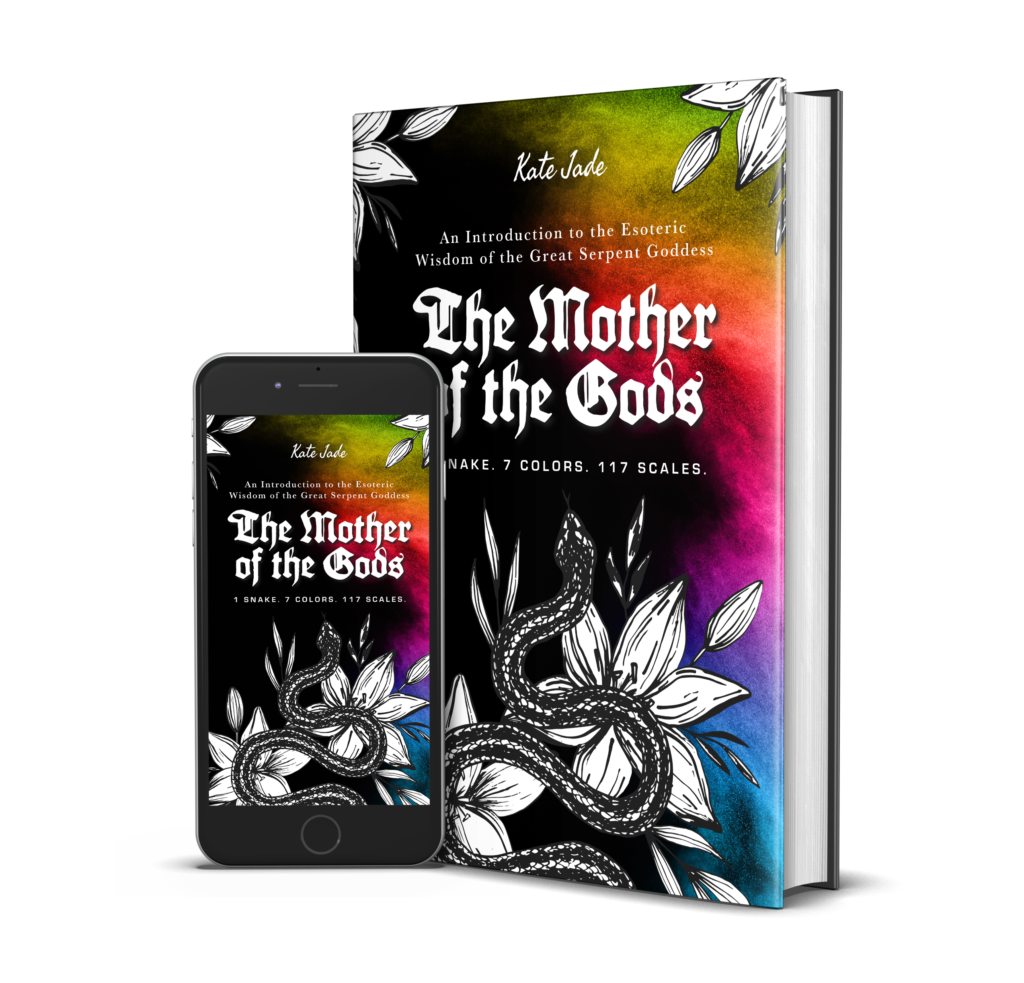
Astarte, the Mother of the Gods, Queen of Heaven, and Goddess of Wisdom is inextricably linked with the number 117. Through many years of research, we found that it was one of many keys to unlocking the outward expression of ancient goddess. 117 is a number of harmonic growth, manifestation (meaning the physical form something takes on), and infinite expansion.
“Even before Heaven and Earth, maybe the Mother of the Universe, there, already existed an inexpressible being. I know not its name, a void and silent, free being. I called it Tao. Immutable and self-sufficient, it is found everywhere. And it is inexhaustible.”
Created by Cambion Art
Though the number 117 sounds random, it is the number of individual epithets of Astarte and it is a mathematically significant number relating to the Fibonacci Sequence (the Golden Ratio).
117 in the Fibonacci Sequence
Cell growth by addition shows divinity through its shapes and proportions. If you’ve ever heard of the Golden Ratio, the Golden Spiral, or the Golden Proportion Relationship, it follows a distinct rhythm known as the Fibonacci Sequence. Starting with 0, 1 is added to create another 1. 1 and 1 are added to create 2, 1 and 2 are added to create and 3, and so on. The last two numbers are constantly summed which leads to the following sequence: 0, 1, 1, 2, 3, 5, 8, 13, 21, 34, 55, 89,144, 233,377,610,987, 1597, 2584, 4181, 6765, 10946, 17711, 28657, 46368...
This pattern is found all throughout our universe. In plants, the spiral arrangement of leaves, petals, and seeds often follows Fibonacci numbers, as seen in sunflower heads, pinecones, and pineapples. Tree branching patterns and the spiral growth of shells, such as the nautilus, also exhibit these mathematical principles.
In the animal kingdom, the golden ratio is present in the proportions of various body parts. For instance, the segments of an insect’s body and the spiral formation of a ram’s horns often conform to this ratio. Even in human anatomy, the proportions of facial features and body measurements frequently align with the golden ratio.
Galactic structures, like spiral galaxies, demonstrate these mathematical patterns on a cosmic scale. The arms of spiral galaxies often form logarithmic spirals that closely resemble the golden spiral. Additionally, the arrangement of planets in our solar system has been observed to roughly follow the Fibonacci sequence in terms of their orbital periods.
In fluid dynamics, the golden ratio appears in the formation and patterns of meandering rivers. It can also be found in the fractal geometry of coastlines, mountain ranges, and cloud formations. These ubiquitous occurrences in nature highlight the fundamental role these mathematical concepts play in the structure and growth patterns of the natural world.
We found the presence of this expansive sequence in so many places, and for the longest time, it was just that. An expansive sequence. A pattern. A blueprint for beauty. All of that dramatically changed, though, when we learned about the importance of 9-digit number systems, also known as a nonary system, rather than the common 10-digit decimal system.
In a nonary system, digits range from 1 to 9, and numbers like 10, 11, 12, etc. can be reduced to a single digit by adding their individual digits. So, 10 would reduce to 1+0=1, 11 would reduce to 1+1=2, and so on.
If each of the numbers in the Fibonacci Sequence mentioned already were reduced to single digits (1 through 9) in this manner, we would get the following:
This can then be turned into a simplified single-digit sequence: 1 1 2 3 5 8 4 3 7 1 8 9 8 8 7 6 4 1 5 6 2 8 1 9
And if we add these numbers all together, can you guess what the sum is? Yes, 117. Don’t believe me? Grab a calculator or pencil and crunch the numbers for yourself real quick.
So, what does this really mean? It means that 117 is a number of the physical manifestation of divinity, or the number of energy taking on a quantifiable form. It is the harmonic growth number of what can then expand into infinite possibilities (such as a spiral growing outward continuously). Within the context of the goddess Astarte, this is the number of ways we can connect to her, relate to her, and begin to grasp her multi-faceted reality. In magickal, witchcraft, and occult spaces, this concept of an entity taking on a “personified mask” for us to be able to understand it, is often referred to as an epithet.
We will speak to each of these epithets as a personified entity or aspect of the Great Goddess because that is how we connect to and understand her, but whether you think of an epithet in conceptual terms or literal personified terms doesn’t make a difference to me, as long as your goal is to understand life, existence, and divinity in a deeper way.
What we discovered through the process of meeting each of the 117 epithets of Astarte is that these fundamental aspects of who she is make it possible for everything else to exist and infinitely expand. Just as the Golden Spiral can infinitely grow, so to can the Fibonacci Sequence continue ad infinitum. Each of these epithets, by nature of being core energies present throughout the universe, are both within us (as we are the microcosm) and around us (as we are a part of the macrocosm).
Interestingly enough, 117 isn’t a number isolated to sciences and mathematics (or even just our own personal discoveries), but can also be found in the folk and magickal traditions of the Mayan and Chinese peoples.
117 in Mayan Traditions
The Mayan Books of Chilam Balam say the following: “The 9 Lords of Time (Bolon-ti-ku) seized the 13 Lords of Time (Oxlahun-ti-ku).” A very early nod to the significance of the number 117, with 9 times (seizing) 13 equaling 117. This was a subtle but powerful way to maintain a tradition that an expanse of multiple divine beings could emanate from the original few lords. Another important tidbit within the Mayan traditions is that their 13 main gods of day and night were divided into 9 gods (masculine) and 4 goddesses (feminine).
We firmly believe that the Mayans saw the connection between spirituality and science. They saw that the mathematical formulas and their knowledge of the cosmos all fit together, telling the same story but through different languages.
117 in Chinese Traditions
In Chinese traditions, their dragons, whether it be in folklore stories or artwork, are typically depicted as having 117 scales, which they almost always describe as being directly linked to Yin and Yang energy. They claim the 117 scales (9x13) are divided into 81 (9x9) of the scales being linked with Yang energy and 36 (9x4) being linked with Yin.
They placed a clear emphasis on the overlap of science, mathematics, spirituality, and folklore—and that is what we intend to also present to you in this book. We see the significance of the numbers in the Fibonacci Sequence and its significance as the formula for the expansion of the universe. We see the patterns in the sacred texts telling the story of Astarte, who is the conscious universe itself. And we see that the two are one and the same, but from different perspectives.
As the Mother of the Gods, no matter who you choose to venerate in your mystical path, Astarte is present. She is the creator of the threads of energy or magick that comprise the fabric of our reality, and that gives way to the infinite possibilities and the vastness of the universe. This is magick that operates on the highest cosmic level and yet directly relates to the nature of our craft on the physical plane of existence, as well as the psychological and spiritual spheres of our reality. Mystic Kate Jade teaches this magick in the in-depth 3.5-year pathworking program called The Mystic's Journey, which is now enrolling.
Bone casting is one of countless forms of divination that people can practice. I especially love bone casting because it based in nature, and though the name indicates working with bones, bone casting sets do not have to be comprised of bones exclusively. Osteomancy is divination solely through the use of bones, whereas bone casting sets can include a range of natural or found items, such as antlers, buttons, acorns, twigs, keys, teeth, coins, feathers, crystals, rocks, arrowheads, and so on.
Bone casting is incredibly adaptable. You get to assign the meaning. You get to add to or take away from the set as you see fit. You get to interpret the results.
Your connection to each item in your bone casting set ultimately drives the way that you'll throw the items and interpret the results. At Astarte's Temple, the bone casting sets we sell have many found objects and are a great starting point for anyone new to the practice, but can elaborately be built onto as you find items and trinkets that hold symbolic meaning to you.
Here are some of the traditional elements that may be included in your bone casting set and ways that you can choose to assign meaning to the item for your readings.
Bones
Historically central to bone casting, actual bones (often small animal bones) represent ancestral wisdom, mortality, and life’s cycles. They act as powerful conduits for guidance from the spiritual realm. Different bones and their lengths, color, markings, or proximity to one another can all have assigned meanings.
For example, a long bone might symbolize travel or journeys because its form suggests movement and distance. Conversely, shorter bones could indicate issues close to home or matters requiring immediate attention.
Relating to the color of the bones, darker bones may be associated with mystery, the unknown, or deep emotions. Lighter bones can signify clarity, truth, or spiritual insight. Some practitioners even use bones from different animals specifically for their color and what that animal represents in various cultural traditions.
Markings on the bones—whether natural or intentionally added—can add another layer of meaning when focusing on the appearance. A bone with a distinctive notch might be interpreted as a warning or a sign of interruption in one’s path. Lines and patterns could suggest timelines, progressions, or connections between life events.
The proximity of one bone to another during a reading is crucial. Bones that land close together might indicate relationships or events that are intertwined; perhaps two areas of your life are influencing each other in ways you haven’t noticed. In contrast, bones far apart could signal separation, distance, or unresolved issues needing attention.
Coins
Coins symbolize wealth, opportunity, and luck. Their presence in a reading might point to financial changes or decisions involving resources. The different faces of a coin can also represent duality—such as risk versus reward. It's important to intentionally assign the meaning to each side of the coin if that will be a factor in your readings and then consistently stick to that.
In our bone casting sets at Astarte's Temple, we specifically include a coin that has YES and NO on either side of it to aid in divination questions that require a precise, definitive answer on a question. This can also be interpreted as positive and negative or even Yang (Masculine/Giving) and Yin (Feminine/Receiving) depending on the symbolic needs of the nature of your readings.
Antlers
Antlers stand for strength, growth, and renewal. They suggest resilience in adversity or the need to assert oneself. Their branching structure can also signify new directions or opportunities. Paying attention to what cardinal direction the antler is pointing toward can also give insight into specific directions or even the classical element that is associated with each direction.
Keep in mind different traditions may associate these things with varying sets of rules, so pick which system you're following and stick with that. For example, if you're following a system that associates the elements and directions as East for Air, South for Fire, West for Water, and North for Earth, be consistent in utilizing that same association every time.
Acorns
A symbol of potential and growth, acorns remind us that great things often have small beginnings. In readings, they may indicate new ventures or ideas ready to take root. You can also assign meaning based on if the acorn has a hat or a stem or other variable factors that could play into the readings.
Buttons
Buttons are connected to themes of relationships and unity—how things come together or fall apart. They may highlight social bonds or situations where things need 'fastening' or resolving. If the buttons have colors, artwork, are made of a certain material, or have a set number of holes, all of those things can be utilized in how you interpret the results.
Similar to coins, you can also assign different meanings based on which side of the button is facing upright as well.
Dice
Dice are classic emblems of chance and fate. Including dice in your set calls attention to elements beyond your control, reminding you that sometimes outcomes are determined by systems of motion on a grander scale in the cosmos.
Additionally, if the dice have numbers or other symbols on them, those can become important factors in the reading as well. For example, dice with numbers can correlate to the symbolic meanings of the number or even dates, times, ages, or other things that have numerical values attached.
Seashells
Seashells evoke emotions, intuition, and journeys—especially those related to personal transformation or healing. Their presence encourages looking beneath the surface for deeper truths. Since shells come in so many different sizes, shapes, colors, and formations, these factors can all play into the meaning you assign to each item.
Brightly colored shells often bring messages of joy, vitality, or creativity. Whites and creams might signify purity or new beginnings; dark hues could point to mystery or challenges yet to be uncovered. The vibrancy or subtlety of color within the cast can influence whether the message is loud and clear or requires deeper introspection.
Markings are equally essential. Natural patterns—spots, lines, swirls—can act as metaphors for life’s complexities. A shell with many intricate lines might suggest that a situation involves unexpected twists and turns; spots could mean scattered opportunities or multiple influences at play.
Shells closely grouped together may signify community support or converging influences in your life. Isolated shells often suggest independence—or perhaps loneliness—while two shells touching might indicate partnership, collaboration, or even conflict if their shapes clash.
Arrowheads
Historically, they represent not only physical protection but also spiritual guidance. When an arrowhead appears in a cast, its position can indicate the need for focus or a clear direction in life. For example, an arrowhead pointing outward from other objects may signify new opportunities or journeys ahead. If an arrowhead lies close to a bone, it could indicate a need to protect the self, loved ones, or resolve family issues. Broken or chipped arrowheads could warn about unresolved conflicts or the necessity for healing. All of these things, though, are ultimately determined by the meaning you assign to each aspect of it.
Crystals & Rocks
Crystals are another common addition to bone casting sets, each offering its own energetic properties. A piece of rose quartz might symbolize love and emotional healing; amethyst can represent intuition or spiritual guidance; and clear quartz could magnify the meaning of nearby objects. The color and type of crystal add layers to the interpretation.
For example, if a protective black tourmaline lands near a bone symbolizing family, it could suggest that the you should shield themselves from negative influences within their domestic sphere.
How to Get Started With Casting
Whether you're buying a starter set (like from us at Astarte's Temple) or 100% collecting and building your own set, the most critical aspect is assigning meaning to each item. The easiest way to do this is by dedicating a journal to your casting and drawing or describing each item. Spend time holding the item and inspecting it and allowing any insights for what the item's potential is to flow to you. Take notes on all of these aspects so you have a reference point as you're getting to know your set.
Buy your Bone Casting Set here from Astarte's Temple!
Much like tarot, oracle, pendulums, or other forms of divination, cleansing your set energetically and establishing a spiritual connection to the tool is important to ensure clarity in your readings. This can be done by keeping in on a personal altar, carrying with you throughout the day in your pocket (if small enough) or in your bag, or keeping it under your pillow or on your nightstand while you sleep.
For me, I often dream and see my divination tools in the astral state and that's how I know I've really bonded with or established a powerful connection to my tool(s). If you have something similar for you that indicates when you're energetically connected to something, utilize that as your frame of reference.
The next step is specifically trust-building with your set. Practice tossing all of the items or randomly pulling a handful of items and casting them on a surface that won't break or chip any of your items. Set your intentions on questions you already know the answer to, such as what you accomplished the day prior or the nature of your job. Pay attention to what items are in front of you, how close they are together, if they're clustered, if there are any outliers, etc. Then shift your focus to the individual items allowing messages to flow toward you as you interpret the results.
Experiment with how you cast, what feels natural, and how you interpret things. And as with anything, practice, practice, practice.
Taking notes on your readings, including what items were tossed and how you interpreted them is a great way to build your reference point for how you understand your readings in the future too.
And remember, your set can constantly evolve. Add or remove items as you feel needed. Assign new meanings or change meanings as you feel you need to as well. This set is wholly yours!
Happy casting!
Ready to learn more about magick?
Join The Mystic's Journey in-depth pathworking program today! Through this 3.5-year program, you'll learn about the seven threads of magick that comprise the fabric of our universe, how to work with these threads to weave your own fate, and truly step into your authentic and unique spiritual path with confidence, clarity, and direction.
Every time a student enrolls in The Mystic's Journey program I've built, they're not only accessing everything I have created and learned, but they're also making it possible for me to continue teaching full time.
What YOU get access to: Coursework to learn about mysticism Rituals, journal prompts, meditations, and more Free downloadable grimoire pages Side quests to learn 42 types of magick Engaging community forum Earn crystals as you complete coursework Beginner and advanced resources App for convenient learning on-the-go
Enroll TODAY and join an incredible community of witches and spiritual practitioners that are motivated by wisdom, embody their magick, and trust their intuition.
It's no surprise that we hold Astarte in the highest regard at Astarte's Temple. To us, her energy is inextricably linked with the goddess Hekate. We view Astarte as the high-level Goddess of Wisdom who gives birth to energy itself, including all of the gods and goddesses, and through this lens, we view Hekate as the primordial energy that emanates from Astarte as the Anima Mundi, the World Soul, that animates all of life itself.
Throughout history, Astarte of the Canaanite Pantheon has taken on the names of Venus (Rome), Isis (Egypt), Aphrodite (Greek), Cybele (Phrygian), Inanna (Mesopotamia), Mary (Christianity), Yemaya (Orisha), and countless others throughout various cultural traditions, time periods, and needs of the people. She is alive today, regardless of what you call her.
Though many view Astarte as a demonized figure, especially through the Judaic and Christian lenses of modern times. The goddess Astarte far pre-dates monotheistic religion and has nothing to do with their faith. In fact, she is a figure that monotheistic religion attempted to utterly erase.
My question to you, dear reader, is two-fold.
First, why would a religion attempt to erase someone who they claim "isn't real"? After all, if she's merely myth, who cares?
Second, what about her is so fearsome that they need to alter her story to make her out to be a wicked force in opposition to their supposed all-powerful, omnipotent god?
As the Mother of the Gods, no matter who you choose to venerate in your mystical path, Astarte is present. She is the creator of the threads of energy or magick that comprise the fabric of our reality, and that gives way to the infinite possibilities and the vastness of the universe. This is magick that operates on the highest cosmic level and yet directly relates to the nature of our craft on the physical plane of existence, as well as the psychological and spiritual spheres of our reality. Mystic Kate Jade teaches this magick in the in-depth 3.5-year pathworking program called The Mystic's Journey, which is now enrolling.
She’s a goddess with roots deeper than Rome—older than Aphrodite. In Sumer, she was Inanna: a goddess of both love and war, who descended into the underworld to face her shadow and rose transformed. In Babylon, she became Ishtar, fierce and untamed. To the Phoenician and Canaanite peoples, she was Astarte, the Queen of Heaven and the Mother of the Gods. And to the Egyptians, she was Isis, the goddess of magick and motherhood. —Where astrology, artistry, and mysticism collide by The Paganista & Astarte's Temple
Though primarily viewed as a feminine goddess with her imagery as the Mother of the Gods, many depictions and traditions recognized her as an androgynous, genderless figure embodying both male and female attributes equally. This element of Astarte is incredibly sacred to us because it showcases her love and acceptance of people exactly as they are. Whether someone identifies as non-binary, androgynous, man, woman, transgender, or any other gender expression, not only are they welcome in the eyes of Astarte, but they are also most certainly welcome here at Astarte's Temple.
Popular Celestial Symbols of Astarte:
Star: Astarte was known as the "Queen of the Stars" and her symbol is the star, often representing the planet Venus. The eight-pointed star is a particularly common representation.
Crescent moon: She was associated with the moon, and sometimes depicted with a crescent moon on her head or standing on a crescent moon.
Sun: In some depictions, she wears a crown with a sun symbol.
Venus: This star symbol was adopted by Astarte, representing her connection to the planet Venus, the morning and evening star. This connection made Astarte a direct precursor to the Greek Aphrodite and Roman Venus.
Honoring Astarte Today
Perform rituals — Many practitioners hold rituals for Astarte in relation to the constellation Virgo, the planetary movements of Venus, and during dawn or dusk when the sun is rising or setting.
Make offerings — Popular offerings for Astarte, include incense (such as frankincense and myrrh), lilies, honey, cakes, and wine. Often, people like to leave these offerings at designated sacred spaces for Astarte that have been cleansed and consecrated to her. She also loves crystals, such as jade, super 7, bumblebee jasper, honey calcite, and emerald.
Volunteering — Due to Astarte's compassionate nature, community service that gives back to those in need is always an acceptable offering to her, especially if it is aimed at helping women, children, teaching others about wisdom and spiritual themes, and so on.
Hekate (Hecate, ˈhɛkəti) is traditionally recognized as a Greek goddess or titan with many associations, such as crossroads, witchcraft, magick, liminal space, doorways, and the like. To us, we view her through an older lens that recognized her as a primordial figure with roots that can be traced back to Mesopotamia, Thrace (near modern Bulgaria), and the Carians of Anatolia (modern-day Turkey).
As the Anima Mundi, she is the World Soul—the energy that animates all. Quite literally, life itself. We like to visualize this energy as the web of creation. created from threads of energy or magick that gives way to infinite possibilities and the vastness of the universe, which Mystic Kate Jade teaches the magick of in The Mystic's Journey Pathworking Program.
As the World Soul, Hekate animates all, she is the life itself.
Hekate was initially portrayed as a benevolent goddess of the wilderness, childbirth, and the moon, and her role later shifted to incorporate the imagery of witchcraft, ghosts, and crossroads. Her worship was already established by the 7th century BCE, with the earliest inscriptions appearing in Miletus near Caria. She was likely adopted by Greek traditions from the older Carian roots. Her first appearance in Greek literature was in the 7th century BCE by the poet Hesiod. He depicted her as a Titan, the daughter of Perses and Asteria, who received honor from Zeus and had power over heaven, earth, and sea.
Hekate as Anima Mundi is the very fuel of creation and destruction, to me and them. It makes perfect sense that she has always been associated with witchcraft since we who identify as such associate with and utilize the primal source from which all types of energy flow. —Keeping Her Keys Blog
Hekate was revered as a Mother Goddess in many ancient traditions, and when we explore how her energy permeates all of creation, and how she is connected to goddesses like Astarte of the Canaanite peoples, who was the Mother of the Gods, it is no stretch to see how motherly she is and the power she has to birth anything into existence.
The Anima Mundi, Latin for ‘World Soul,’ is the concept that the world is a living entity imbued with a universal spirit that animates and unifies all things. Both Hekate, from Greek mythology, and Sophia, from Gnostic traditions, represent distinct yet complementary aspects of this World Soul, each embodying unique attributes that contribute to the overall harmony and wisdom of the cosmos. —Angelorum Substack
Popular Symbols of Hekate:
Torches: Represent her role in bringing light to darkness and her connection to the night. I love sharing with people how the torch of Hekate is connected to Lucifer.
Keys: Symbolize her power over gateways, both literal and metaphorical, and her role as a guardian of thresholds.
Dogs: Often seen with her, dogs are associated with both protection and the underworld.
Polecats: One legend pertaining to Hekate describes her having compassion on a deceitful witch who was turned into polecat, taking her in as a sacred servant of her own.
Serpents: Symbolize rebirth, renewal, and her connection to the earth and chthonic realms.
Crossroads: A central symbol representing her dominion over boundaries and liminal spaces.
The Moon: Associated with her through her connection to the night, cycles, and the dark moon.
The Strophalos: Also known as Hekate's Wheel, this spiral labyrinth symbol is unique to her and is linked the soul's journey.
Honoring Hekate Today
Hekate's memory is kept alive today by many who are drawn to the mysteries, that which is hidden, and the esoteric wisdom of ancient times. She has countless epithets and personifications she takes on, and can be venerated according to traditions of old or through newer methodologies.
Perform rituals — Many practitioners hold rituals on the night of the dark or new moon, known as the Deipnon, in honor of Hekate. Rituals can include bonfires, making offerings, pouring out libations, singing and dancing, baking bread or cakes, and so on.
Make offerings — Popular offerings for Hekate, include incense (such as frankincense), tea, flowers, keys garlic, eggs, honey, cakes, and red wine. Often, people like to leave these offerings at a crossroads, and are intentional to place the offerings on the ground (preferably items that are safe for local wildlife and the environment, so no trash) and not look back after it has been given.
Volunteering — Due to Hekate's love and association with dogs, women, and children, many opt to volunteer as an offering to Hekate by donating their time or giving to local animal shelters, foster youth organizations, or women's shelters. Anything that gives back to those who are in need can be done in Hekate's name.
We often get asked how to go about using ritual oils in a person's practice—and in all honesty, the beauty of magick is that there are infinite ways to go about it. Here are a few of our favorite ways to use ritual oils, though.
For starters, the way a ritual oil may be used is going to depend on both the intention of the oil itself and the practitioner who is using the oil. Many of the ones we craft and sell through Astarte's Temple are intended to help people connect with specific divine beings, such as Hekate, Lilith, or Aphrodite.
Daily Wear
If the ritual oil is skin safe (as ours are), they could be dabbed onto the wrists or neck to connect with its energy as you go about your day. This could be added with intention, meditation, or prayer asking for protection, wisdom, or guidance of the respective divine being that the oil is for.
Some ritual oils may also be intention based rather than for a specific divine being, such as Protection Oil, Abundance Oil, etc. and these can be worn to draw in that energy throughout the day.
Rituals
One of our favorite ways to use ritual oils is in a ritual itself. We like to use the oils to anoint candles or other ritual tools as part of the working. For chime or pillar candles, the oil can be dripped onto the outside and then rolled in dried herbs. For candles contained within a jar, the oil can be dripped around the outside edge and then dried herbs can be sprinkled in away from the main wick.
When working with Hekate, we especially love to use her ritual oil to anoint a candle for her and include some of her favorite herbs like mugwort, wormwood, and damiana.
Spellwork
In spellwork, oil could be added to a spell jar or spell candle to include its energy in the working of your intention. For example, a spell to open pathways and opportunities could utilize a ritual oil for Hekate, as she is the Goddess of crossroads, thresholds, and liminal space.
Simmer Pots
Ritual oils can be added as an ingredient to a simmer pot to draw in its energy into your home as part of a hearth magick working. Additionally, it could be used to anoint and bless the doorways and walls of your home to provide additional protection and support when cleansing and protecting your living space.
Protection Work
Ritual oils are also great for protection and healing workings, such as locking mirrors in your home, anointing your candle in a cord cutting ceremony, returning negative energy back to its original sender with a baneful ward. At the end of the day, your magickal craft is solely your own, and there countless ways to use all spiritual tools.
The biggest things to consider are what your intentions are, what the intentions of the ritual oil are, and if applicable, things like if the oil is skin safe, safe around pets and children, safe to burn, and so on. Happy crafting!
Join The Mystic's Journey in-depth pathworking program today! Through this 3.5-year program, you'll learn about the seven threads of magick that comprise the fabric of our universe, how to work with these threads to weave your own fate, and truly step into your authentic and unique spiritual path with confidence, clarity, and direction.
Every time a student enrolls in The Mystic's Journey program I've built, they're not only accessing everything I have created and learned, but they're also making it possible for me to continue teaching full time.
What YOU get access to: Coursework to learn about mysticism Rituals, journal prompts, meditations, and more Free downloadable grimoire pages Side quests to learn 42 types of magick Engaging community forum Earn crystals as you complete coursework Beginner and advanced resources App for convenient learning on-the-go
Enroll TODAY and join an incredible community of witches and spiritual practitioners that are motivated by wisdom, embody their magick, and trust their intuition.